
# WorldWideMarkets Episode 689 — Transcript
Mr Price and Clicks: end of an era or an entry point?
Simon Brown | 4 August 2026 | 11:23
*Lightly edited for readability. Powered by Standard Bank Global Markets Retail and Shyft.*
—
Worldwide markets this week: Mr Price and Clicks — end of an era or an entry point? Both are being hated by the current market. Let’s dig in and see where they sit.
Simon Brown, this is WorldWideMarkets episode six hundred and eighty-nine for 5 August, and I am recording this late on Tuesday morning, a little after eleven o’clock.
WorldWideMarkets is powered by Standard Bank Global Markets Retail, and by Shyft — the global money app that puts travel, shopping, payments and investments in the palm of your hand. Enjoy the cheapest forex rates anytime, anywhere. Shyft, powered by Standard Bank. Thanks to Standard Bank, thanks to Shyft.
Remember, that transition from Online Share Trading to Shyft is happening in the next couple of weeks. Keep an eye out — you will be getting an email with the details. We will also be doing some webcasts and more, so that everyone gets a sense of exactly where we are.
## Two stocks, two very different businesses
Mr Price and Clicks. I hold both at this point, in varying degrees and in varying degrees of profit. My Mr Price is in the money, my Clicks is a little underwater.
We have two stocks that have been absolutely massacred. Both charts look the same. But the businesses underneath them do not. And that is what I want to delve into today. What have we got underlying these two businesses? Is there something there? Is there opportunity? Is there an investment case for one or the other? And importantly, I want to understand what those differences are — because on the surface they might look the same.
## US earnings season
But before I get to that, I quickly want to touch on earnings season. The numbers coming out of the US have been — what is the word I want to use? — knocking it out the park.
I chatted with Gary Booysen on my show on Tuesday morning and my question was quite simple: how are we doing? The answer is we are doing incredibly well. When earnings season started, the expectation for the US was steep — very, very steep — looking for around 23% earnings growth for the period. We are about two thirds of the way through and we are at about 47% growth.
Now to be clear, there are some Ts and Cs in this. We had Amazon’s big stake in Anthropic being revalued. We had Alphabet’s big stake in SpaceX, and a smaller stake in Anthropic, being revalued. That has certainly helped. But if the question is how has US earnings season been so far, spectacular is the answer. Just simply spectacular. Make no mistake about that — it has been an incredibly strong earnings season.
And you know what we are seeing? I am going to write about it for my Financial Mail article. We are seeing margins continue to expand. My concern with expanding margins is that at some point competitors come in, because there is just too much profit. So margins cannot expand forever. But so far, margins are expanding forever.
## Power Hour: building an ETF portfolio
Next week, 12 August, we have a Power Hour. That is a Wednesday, 5:30pm as always, on webcast — or you can come in person to the Standard Bank head office in Baker Street. We are at 33 Baker, just across from the main building at 30 Baker.
ETFs. Everyone says just buy them, but the question is: which ones? We want to buy and hold them — so which do we buy? Where do we start? And as our portfolio grows, how do we construct that portfolio? That is what I am going to be looking at, whether you are starting with your first thousand rand or whether you have got your tax-free through to a million rand. Head to justonelap.com/events for more information and booking.
## The valuations: Clicks and Mr Price side by side
So let’s dig into Mr Price, let’s dig into Clicks, and let’s see where that value is. First some simple stuff — charts and the like — to get a sense of exactly where we sit. Then we will go into the detail.
**Clicks.** What we have here is really quite simple, and I have touched on this before. Looking back at a ten-year mean of their P/E, that is about 30 times. One standard deviation below is about 25 times. Current is sub-15. The stock has not been this cheap in a decade, by a long way. Price to book: the ten-year mean is around 12, one standard deviation below is 10.7, current is 8.1.
So it is on a P/E of around 15 and a dividend yield of around 4%. Both of those are, for Clicks, really cheap. Absolutely proper, proper cheap.
What about price targets? The low is R235 and Clicks is at R219. The average is R328 and the high is R392. You will note it never gets above that average — it tends to trade between the low and the average, so call it a range of R235 to say R325. It is below that right now, sub-R220. Three holds and five buys, no sells on the stock at all. So by all accounts the stock is looking cheap on that measure as well.
And if we look at a chart, it is trading at three-year lows, five-year lows. Cheap levels. I think we can go back almost a decade — okay, not quite a decade, but it certainly is back at pre-pandemic levels where Clicks is trading right now.
So Clicks is cheap by every measure. But is it the end of an era, or is it opportunity? That is the real point.
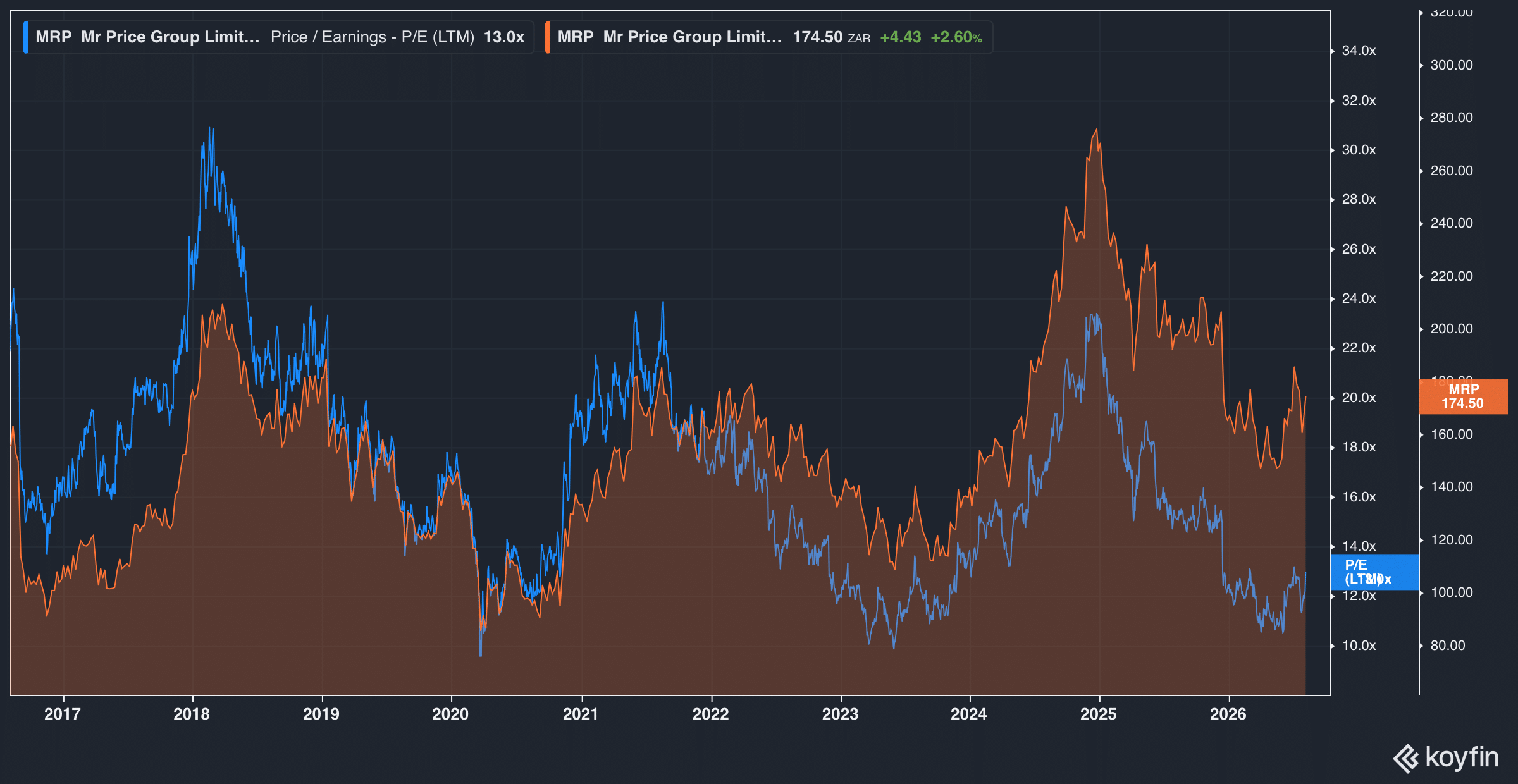
**Mr Price**, on the same sort of metrics. Dividend yield of 5.3%. Current P/E is 12.2. On a ten-year view the mean P/E is 17, one standard deviation below is 12.9, and as I said we are at 12.2. The forward is 11.2. Price to book: the mean is 5.1, one standard deviation below 3.2, and we are at 3.1. Cheap on both.
A 5.3% dividend yield — that is not a bad-looking dividend yield, I have to say.
If you look at analyst expectations, there is a high analyst sitting at R568. I think they were drinking too much; that number makes absolutely no sense. Although it does look like it has been adjusted, and this isn’t just a single bad number — there are a lot of numbers in there. We have four buys, four holds and one strong buy, with an average price of R238. The low is R173, and that is pretty much where Mr Price is right now. Again, on a ten-year view it never seems to get to the average — it seems to trade at around that low analyst expectation, which is roughly where it is now.
On the chart, it is not looking too bad. It made a bit of a double bottom in April into May. It ran nicely into the 180s, then pulled back. We are getting higher lows. If we can now break through around 185, 186, we are getting higher highs. Not looking bad. There is a bit of resistance at about 175, which is where we are right now.
So maybe Mr Price is looking better on the chart, but both are looking cheap. Clicks is trading at roughly half its ten-year median, Mr Price around 25% below.
But what is the story here? As I said, the charts look kind of the same — massive, massive sell-off — but the businesses underneath them do not.
## The SA consumer: the pain is at the top end
The macro story, let’s quickly touch on that. We know we have had fuel increases. Inflation at 5%. Prime up a quarter percent in May, although no July increase — thank you, Mr MPC. This is hurting consumers.
But interestingly, what we are really seeing is perhaps more pain at the top end. That Woolworths update told us a bunch — they had a really tough second half. High-income shoppers are shopping down. High-income confidence collapsed from -4 to -28. Fifty-three percent of affluent households now expect the economy to worsen; it was 13% three months ago. So that high end is absolutely hurting.
And that is bad for Clicks. Discretionary, beauty, skincare — those are the more affluent shoppers. Mr Price benefits: low-cost fashion retail, 91% cash sales. So Mr Price is perhaps better positioned in this sort of environment.
We saw the last bit of food inflation at 1.6%. We have seen transport prices come back markedly — and the taxi fares didn’t jump as much as filling my car with diesel did. The taxis went up a little bit in places, but they broadly absorbed it.
So weirdly, and it is not intuitive, the pain is actually more at the high end than the low end. When I dug into the numbers, that absolutely boggled me.
## Mr Price: the business is better than fine
So Mr Price — the business is fine. In fact, maybe better than fine. Relative to the market it is looking quite good.
The first quarter of FY2027 — the 13 weeks to 27 July, published on 23 July, so just over a week ago. Group sales up 45%. That is completely distorted by the NKD deal. But what we did see was African organic growth up 3.2% against an industry up 0.8%. That is a 2.4% outperformance, and that is a big number. South Africa up 3.5%. Apparel up 3.4% over a South African market that was again flat, so picking up market share. Homeware up 0.7% where the market was up 5.8% — so they fell behind there, but it is a small section at this point. Telecoms up 11%. Comparable stores were flat; the growth came from new stores and from NKD, of course. Gross margins at 40%.
NKD is the big deal. It really is all about NKD, and we know this. Management’s defence: CEO Mark Blair points to Studio 88 and says we had the same scepticism there — different scale, and it worked. He also says this isn’t about synergies. Synergies is the worst word in the world when we are talking about deals. He says this is not about synergies — these guys are in Germany, they are in Eastern Europe.
Where Mr Price does have a weakness — and this surprised me — is online. I have to say I hadn’t thought about it, but Mr Price just doesn’t have much online: 2.4% of sales. That is absolutely tiny. And to be clear, fashion retail does do online. Truworths is at 7.4%. Bash is doing something like R2bn of sales. Mr Price needs that number to be a whole lot higher. It should be double, if not triple. Easily triple. Is that opportunity? Sure — but they obviously haven’t solved it yet.
And then Shein and Temu. Make no mistake, those are hurting. They are absolutely hurting, and they are cheap. I know we have had all the debates around proper taxation on the way in, et cetera, et cetera — the story is that just isn’t happening. We can say what we want, at this point in time it just is not happening, and that is the key thing.
So really, Mr Price is actually looking quite fine. As I said up top, the business is fine — better than fine — and doing better than many of its competitors in the local space. It is all about NKD.
## Clicks: the headline was fine, the detail was not
Clicks. The headline looked fine, but the details did not. And maybe that is the story here — when you start to delve in.
It is losing share in the categories that make it money. It is gaining share in pharmacy, which is great, but that is a regulated industry, and there is not that much margin around pharmacy. It is losing share in skincare, in front-shop health, in OTC — the high-margin discretionary. That is the part you cannot afford to lose.
Volume has dropped. Retail volume growth of 0.8% in H1, 1.3% over the first 20 weeks, down from 2.4%. Clicks is struggling. Selling price inflation of 2.3%. The medicine price adjustment — the single exit price we have in South Africa — at 1.47%. There is no tailwind here. There is no pricing power coming in.
Execution has failed. They had that warehouse management problem down at the Cape Town DC: R120m in lost sales by mid-January, R175m by end-February. This is a management team that could make no mistake — and they made a mistake that cost R175m. That is alarming.
They have also got three competitors coming for them, and they are very well capitalised.
**Dis-Chem** is essentially buying customers with their loyalty card, that Better Rewards programme. Launched — was it October last year? It brought in over half a million shoppers in 17 weeks who hadn’t been into a Dis-Chem in a year. I went into a Dis-Chem recently, not for the Better Rewards programme — I forget what I was looking for. It was a weird experience. They sold toys, and right next to the toys there is Doom. Yes, the Doom you spray the bugs with. Anyway, I hadn’t been into a Dis-Chem in absolutely years and years. So Dis-Chem is coming for them.
**Shoprite Checkers.** Part of Clicks’ moat is that over 50% of South Africans are within five kilometres of a store. Where I sit right now in Rosebank I have got one in the Zone and one in the Mall — they are both maybe 150 yards away, and I have two of them. It seems like a lot. But Sixty60 makes proximity irrelevant. Checkers is now saying: boom, we can deliver you your medicine in an hour. Whereas Clicks has no on-demand delivery. Now, there are Ts and Cs around regulation. But imagine being able to get my medicine delivered via Sixty60 in an hour, nice and simple, instead of driving those five kilometres to a Clicks. Ouch. Big ouch. Still to come, but getting there.
We also saw **SPAR** acquire Aptekor in October last year — about 120 pharmacies. And **Woolworths** is going big into beauty.
The point is that these are rich, well-capitalised businesses looking at Clicks and saying: we would like some of what you have got there.
FY26 diluted HEPS guidance was 4% to 9% growth. That is after FY25 delivered plus 14.1%, and with expanding margins. So they are basically guiding half the growth rate — and if they only get 4%, that is below inflation. And where is my expanding margin? Vanished. Gone.
## Which one do you back?
So with Mr Price, you are basically underwriting a management decision. With Clicks, you are underwriting a competitive position: can they compete? These are different types of risk, and they deserve very different types of solution.
Is it fixable? With Mr Price — yes, deliver on the deal. That is it. Deliver on the deal and the market re-rates. I have said it before on this show: we have the stock being marked down by the value of the deal. Mr Price has lost that market value since announcing the deal late last year. The market is basically saying NKD is a mistake, a disaster.
It doesn’t have to be good. All NKD has to be is not a disaster. It just has to be okay. If it is just okay, that is a win, and Mr Price is off to the races.
Clicks is harder. It needs competitors to stumble. One of them, maybe — but it has got three, it has got four, and they are all coming for its lunch. It is not the margin, it is the volume growth: 0.8%. You cannot compound 0.8% growth. There is nothing to compound.
So with Clicks, you are betting the market overshot. With Mr Price, you are betting management got it right. You pick your winner there. Choose your fighter.
As I said up front, I hold a bit of both. Having gone through all of this — and I spent a couple of hours on Monday afternoon and Tuesday morning prepping for this — I have to say it makes me a little more confident holding my Mr Price position, and a little more worried about holding my Clicks position.
What is the view from here? There will be results coming. We will get numbers that give us more detail, more colour, more of a sense of where this goes. And I have said this before: foreigners used to be giant holders of Clicks and they have absolutely backed off. At the moment, in SA Inc equity, if you stumble by the smallest amount the market punishes you immensely. Clicks is stumbling, which for Clicks management is absolutely unusual. That is perhaps the key point.
Whereas with Mr Price, the market hated that deal. Make no mistake about it, the market hated it. But if they can just make it an okay deal, then suddenly everything starts to turn out okay.
So let’s see how it plays out. I have got a bit of both. I think Mr Price is the easier one. Clicks is probably the better value, but it needs to do a lot more to get that re-rating.
I am also building my filter for looking for value on the JSE, and I am going to look at that maybe next week or the week after. I think there is a lot of value lurking on the JSE. Maybe it is brave to buy it, because as I said there is a lot of hate out there. But let’s see how it plays.
## Oil and the Strait of Hormuz
WorldWideMarkets is powered by Standard Bank Global Markets Retail, and by Shyft — the global money app that puts travel, shopping, payments and investments in the palm of your hand. Enjoy the cheapest forex rates anytime, anywhere. Shyft, powered by Standard Bank. Thanks to Standard Bank, thanks to Shyft.
Before we go, just one thing that came through. There is a lady I follow who is an expert on the Middle East and energy — and that really is the point. I follow her on Twitter, of course, because that is where you follow people. She made a really interesting point a couple of hours ago on Tuesday morning: even if the Strait of Hormuz reopened today, replenishing depleted inventories could take up to 18 months at an average rate of 2.1 million barrels a day. That is from Aramco CEO Amin Nasser — they have just had results out.
So it is going to be a while before oil is back at $60, I suppose is the answer. We are currently back at around $80, and I am quite happy with $80 — it is better than $100, better than $120. But it is going to take some time, because we have been drawing down strategic reserves. We have seen it across the industry around the world: with LNG, with fertiliser, the urea component, and of course with oil. Your production would normally have some extra storage capacity — that has all basically been drawn out of the system, along with strategic reserves. And that will need to be replenished. Saudi Aramco says that could take a year and a half. So we are going to see pain for a little bit longer.
But let’s leave it there. My name is Simon, we will chat again next week. A heads up: the second week of September — which is a long way away — I am going to be spending on the beach. I don’t know if we will have a show, but that is a long way off, so we will worry about it then.
Until next week, my name is Simon. As always, look after yourself, and if you can, look after somebody else as well. Cheers all.
Episode Summary
Mr Price* and Clicks* have both been massacred by the market, and their charts look almost identical. The businesses underneath them do not. Simon holds both, and this episode is him working out which one he actually wants to keep — Clicks on a sub-15 P/E for the first time in a decade, Mr Price on 12.2 times with a 5.3% dividend yield and a R9.6bn German acquisition the market has already written off.
Sponsored by Standard Bank Global Markets Retail & Shyft
What We Cover 🗂️
- 📊 US earnings season running at 47% growth against a 23% expectation — and why expanding margins worry Simon
- 🎟️ Power Hour on 12 August: how to actually build an ETF portfolio, from your first R1,000 to a R1m tax-free account
- 💊 Clicks on a sub-15 P/E and 8.1 times book — the cheapest it has been in a decade
- 👕 Mr Price at 12.2 times earnings, 3.1 times book, 5.3% dividend yield, trading at the low end of analyst targets
- 🛒 The counter-intuitive SA consumer story: the pain is at the top end, not the bottom
- 🇩🇪 NKD — why Mr Price only needs the deal to be “not a disaster”
- ⚔️ Dis-Chem, Checkers Sixty60, SPAR Health and Woolworths all coming for Clicks’ lunch
- 🛢️ Saudi Aramco: 18 months to refill global oil inventories, even if Hormuz reopened today
Key Takeaways 💡
- Same chart, different risk. With Mr Price you are underwriting a management decision (NKD). With Clicks you are underwriting a competitive position. Those are not the same bet and they do not deserve the same treatment.
- NKD does not have to be good. Mr Price has shed roughly the value of the deal since announcing it — the market has priced a disaster. If NKD merely turns out okay, that is a re-rating.
- Clicks is losing share where it makes money. It is gaining in regulated, low-margin pharmacy and losing in skincare and front-shop health — the high-margin discretionary stuff. Retail volume growth of 0.8% gives you nothing to compound.
- The execution slip matters more than the number. A warehouse management problem at the Cape Town DC cost R120m in lost sales by mid-January and R175m by end-February. Clicks is a management team that historically did not make mistakes.
- FY26 guidance tells the story. Diluted HEPS growth of 4–9%, after FY25 delivered +14.1%. At the bottom end that is below inflation, with the margin expansion gone.
- Simon’s read: more confident holding Mr Price, more worried about Clicks.
-

Mr Price ten-year chart (Weekly) | Price & PE | Close 04 Aug 26
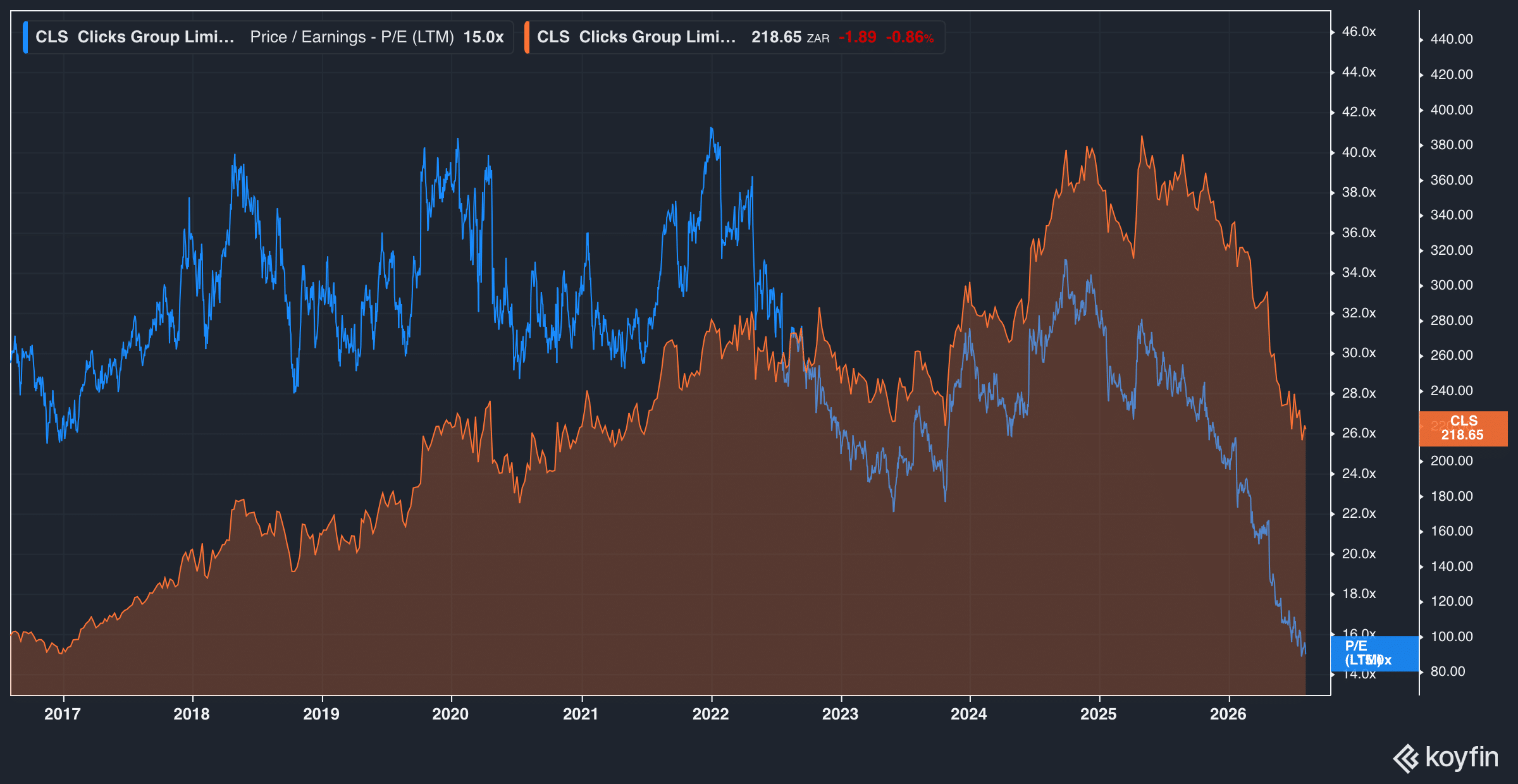
Clicks ten-year chart (Weekly) | Price & PE | Close 04 Aug 26
All charts by KoyFin | Get 10% off your order

Wednesdays are all about hard-core investing and trading with Simon Brown’s WorldWide Markets podcast (previously JSE Direct). JSE Direct started life on ClassicFM in July 2008 and became a podcast in 2011. Every week Simon shares his views on the state of global economies, individual shares and events moving markets.
Contact Simon
More about Simon


