
61,645 cars sold in September in South Africa, the most in nearly 20 years. But WeBuyCars is down 47% year to date and Motus 12%. What is the market seeing that the sales figures are not? This is Worldwide Markets episode 697. We are recording on Tuesday afternoon for this podcast, webcast, video cast, whatever it might be, for 7 October. Worldwide Markets, powered by Standard Bank Global Markets, Retail and Shyft, the global money app that puts travel, shopping, payments and investments in the palm of your hand. Enjoy the cheapest forex rates anytime, anywhere. Shyft, powered by Standard Bank. As always, thanks to Shyft for the sponsoring and to Standard Bank.
A bit of housekeeping here. I want to mix things up a little and bring some better structure to this podcast, video cast, whatever we’re going to call it. One of the changes is that I want to kick off with a chart. I know charts are a little difficult for those of you on the audio, but trust me, you can go and find it on my socials. The point being, they’re going to be simple charts, because I’m a simple chap.
This one is US unemployment. It came out on Friday at 4.2%, up from 4.1% the previous two months. Everyone’s talking about it: ooh, US unemployment, jobs are getting a bit weak. Non-farm payrolls was a miss, 130-odd thousand expected and we got 30,000, with revisions downwards for previous months, et cetera, et cetera. But man, after the global financial crisis unemployment got to almost 10%. In the pandemic it got to almost 16%. Just ahead of the pandemic it was sub-4%. Of the G7 or G20, only Japan is anywhere near this, with around a 2% unemployment rate. This is pretty much full employment.
The American economy is doing just fine. To be clear, it has challenges: the gasoline price is hurting, interest rates are hurting, et cetera. But that build-out, the almost a trillion dollars being spent on the data centre rollout, is going somewhere, and it’s not just going to chips. It’s paying salaries, it’s doing HVAC, it’s building transmission lines, all of those sorts of things. I would not be overly stressed about the US economy. It does leave an interesting point for the powers that be, and here I’m thinking of the Federal Reserve, because inflation is a little sticky, quite high, and has been above target for five years. So things are maybe a little bit messy in that regard.
We have a Standard Bank Power Hour event on 22 October at 17:30, via webcast or in person at the Standard Bank head office in Baker Street, Rosebank, Johannesburg. Actively managed ETFs: we are seeing a wave of them coming this year, and we want to look at why and how. I want to dig into, for example, the fact that active management typically does no good, but are there areas where active does do better? The answer is yes. There are also some of these ETFs that are actively managed, but they’re actually systematic strategies where there simply wasn’t an index. So the good, the bad, the ugly and the wonderful. Justonelap.com/events for more information and booking.
Worldwide Markets.
So, the car story. Let’s start with the fact that we do have massive numbers. When I say we’re having the best sales in almost 20 years, I mean that literally: we have to go back to 2008 to last see this level of sales. Sales were weirdly falling going into the pandemic, and they’ve been climbing coming out of it, and now we’re getting really, really big numbers. The question is why we’re getting these giant numbers when the consumer is under pressure, and on the flip side, why the stocks are hurting. So we’re going to look at Combined Motor Holdings (I hold it), Motus, WeBuyCars, Super Group, Zeda and Metair.
The story is really quite simple. New vehicle sales are at two-decade highs, so why aren’t the shares following the volume? The volume boom is absolutely real. But it’s the margin. That’s where we’re getting the squeeze. The market is pricing this as a cyclical peak. Unit sales are up because cheap, well-specced Chinese, Indian and other Asian vehicles have pulled buyers into the showroom. And that price war is crushing pricing power. Absolutely crushing it. That sweet spot of R300,000 to R450,000, where WeBuyCars built its business, is now competing directly with new, well-specced Asian cars. To be clear, well-specced. So that is hurting WeBuyCars, and the other folks who are leaning into Chinese and Indian brands are struggling with margin. So yes, the sales are real, but it’s about where they fit.
And also, to be clear, petrol and diesel are at R30-plus. We’ve had two rate increases, and prime is up half a percent. So the sector is on single-digit PEs with dividend yields of about 6% to 12%. To put it right up top: Motus is probably the top pick, Zeda for income. CMH, which I hold, is the pure SA play. Super Group is cheap, but not really a car story. WeBuyCars, wait for the full-year trading statement. Metair, avoid it.
But let’s get into some actual numbers and where it really fits, because this really does matter, and there’s some powerful data coming through, also in terms of where the cars are being sold. September naamsa: 61,645, up 12.7% on the same month last year. That is really giant. Total domestic sales up, passenger vehicles up almost 15%, light commercial up almost 10%, medium commercial up 3% and heavy trucks and buses flat. Exports down 18.8%. That is a big deal. Channel split: dealers 81.4%, rental 13.8%. That’s a lot; it’s 18.4% of passenger cars, and we’ll come back to that. Government just over 2.5% and corporate 2.1%.
Toyota had its best month ever, a 24.9% share. Chery broke 3,000. GWM got to 2,700, Jetour 2,036, and Omoda & Jaecoo 1,503. Chinese brands were about 16% of September sales. TransUnion and Cars.co.za put Q1 and Q2 at about 19% to 22%. So absolutely, the sales are there and they are happening, but there are Ts and Cs as to where and how.
The export number was interesting. Exports collapsed, down almost 19%, and I think that might in part be concerns around where we are with the motor vehicle benefits, but also exports into the US. So some numbers flatter. Rental is a very lumpy buyer. They typically stock up in September ahead of the holiday season and then defleet six to twelve months later, so that volume comes back as what they call near-new stock. It is a real sale, it is fleet volume. It’s not you and I buying, but it is going through.
Then there are some blurry lines. Motus imports and distributes Hyundai, Kia, Renault and Mitsubishi, retails them, and owns rental operations including Europcar and Tempest. CMH has First Car Rental, and Zeda runs Avis and Budget. Interestingly, if a car moves from an importer to a sister rental company, it is considered a sale. Demos sit within the dealer channel, and naamsa doesn’t split out demos at all. Is there an incentive to register stock as demos to hit sales volume targets? Maybe. The idea would be that you claim a car is sold, put a hundred kilometres on the clock and put it on the floor as a demo at basically the same price. I saw a lot of that two or three years ago with the Suzuki Jimny, the three-door, not the five-door which has now come out. Is it plausible? I don’t know. I’ve heard people say it, but I can’t find any evidence for it at all.
So Chinese cars: great for volume, terrible for pricing. Motus saw Chinese and Indian volumes up more than 200%, including Tata, with dealer volumes up 20%. At Super Group, Chinese brands are a quarter of its new vehicle sales. At CMH, nearly half of new vehicle sales are now Asian brands. But on price, TransUnion has new vehicle price inflation at its lowest ever, 1.2%, and used vehicle prices down 1.9%. How do you compete when your used vehicles are going down in price? So, dealer margin: CMH’s operating margin was flat at 4.8%, notwithstanding revenue up 18.6%. And that’s the trick. That is the absolute point.
WeBuyCars gets really, really interesting. AutoTrader puts the average used car at about R430,000 to R440,000, which is smack bang where Chinese crossovers and EVs are priced. You can get a Geely E2 or BYD Dolphin Surf from around R325,000 up to R400,000 for the top spec, with hybrids coming in at R425,000. Here’s an example from AutoTrader’s April 2026 used car data. Chinese vehicles: an average price of R382,000 for a 2024 car with 29,000 kilometres on the clock. Non-Chinese: R437,000 with 72,000 on the clock. In other words, for a two-year-old car, the Chinese version is R55,000 less with a third of the mileage. Boom.
It’s China. And in terms of some of those crossovers, and to be clear I’m not a petrolhead: the Haval Jolion is R302,000 and the Toyota Corolla Cross R393,000. That’s a R90,000 difference. The Chery Tiggo 4 Pro is R267,000 and the Kia Sonet R318,000. That is a R50,000 difference. There are some of you out there who absolutely know what the differences are, and you’re saying, “But Simon, this and that.” But I look at them and they’re cars. In fact, I think the Haval looks nicer than the Corolla Cross. And the Kia, well, okay, there’s your problem: the Chery looks like it’s competing. And they come with bells and whistles.
I remember when BYD rolled out their version of self-driving. What did they do? They rolled it out to every BYD in the world. Boom. Tesla sells it to you for, what is it, five or eight thousand dollars, and then it’s dodgy. With BMW you get the different levels, and the Chinese carmakers are just like, yo, we’ve got one spec: everything, just stick it all in. That’s the competition, and it is hard to beat.
WeBuyCars’ interims, to March 2026: trading margin 12.5%, down from 14.2%. Inventory days 33.2, up from 28.9. Operating cash flow down 77% to R65 million. HEPS down 1.7% to R1.20. It’s had to cut prices to move stock. And the trick is that Chinese cars eventually become used cars. This is already starting to happen to a degree. We’re not sure about resale, we’re not sure how good they are. Take that R300,000 Chinese car, or the BYD Dolphin Surf extended range at call it R400,000. It’s going to hit the second-hand floor at what, R200,000 or R300,000? It’s going to help WeBuyCars in terms of volumes, maybe, but not in terms of revenue, because they come in so much cheaper. So it’s hurting. The volumes are absolutely there, but the numbers are not there anymore.
Demand is not the problem; it’s pricing in the rental space. Zeda’s rental revenue was down 2.7% in a highly price-sensitive environment. You’ve got cars sitting at the airport, gathering dust, getting hailed on. What do you do? You drop price. That’s how you move stock. So they saw leasing up and car sales volumes up, but rental revenue down notwithstanding. Motus’ rental revenue was up 6%, with utilisation from 71% to 73%. That’s a nice number. And as I said, the rental companies are buying hard, at 18.4% of passenger vehicles, which is typical for this time of year. Then Zeda: nearly-new cars at about R200,000 are an underserved area, and that’s your sort of hedge against the Chinese.
NEVs, new energy vehicles: hybrids and EVs. I think it’s a hybrid market at first, and EVs will come later. On my MoneywebNOW show on Tuesday I was chatting with Alan Quinn from Cars.co.za, and he was talking about the plug-in hybrid. That gives you about 80 to 100 kilometres of battery, which is your runaround: go to work, go to school, go have dinner, that sort of thing. When you want to do the long stuff, boom, turn on the ICE engine and off you go. But every EV under R800,000 is Chinese. Every EV under R800k is Chinese.
Fuel prices, petrol and diesel at R30: that is going to be hurting, and people are looking at it. These days the second most important thing is fuel efficiency. It’s total cost to purchase, and part of that is how much the thing is going to cost to run.
So volume isn’t profit, and that’s the problem. Price deflation, a shift to cheaper cars, lower margins, and used car deflation hitting everyone: trade-ins, inventories, rentals, lease residuals and WeBuyCars’ margins. It’s just hurting. Rates have turned, consumers are under pressure, and we know what’s happening to petrol. I think it’s peak cycle pricing. This looks kind of late cycle, and I think we’re probably at that peak. We’re also seeing some brand fragmentation risk. Mazda used to sell 1,500 cars a month; now they are nowhere on the list. And I think with WeBuyCars we’re looking at a de-rating. That’s going to happen. Metair is just an absolute mess.
What the bulls would say is that a bigger car parc means more servicing, more parts and more used car transactions, and that benefits the sector, particularly Metair, but Metair has got some other issues.
So let’s have a quick look at the different stocks and where they fit. I’ve said already it’s probably Motus. Now, I own CMH and I’ve owned it for about a decade. Do I now rush out, sell my CMH and buy Motus? No, because how much is Motus going to outperform CMH, against the massive tax bill I’d face? New money would potentially go in, but I’m not looking at putting new money into the consumer at this point at all.
So this is the data. Motus is down 12% year to date, on a valuation of about six-odd times PE, and probably the top pick here, with a dividend yield of 6.6%. Zeda has got a 12% dividend yield and a PE of around four. These numbers are just absolutely crazy. CMH I like: the final dividend was 222c and the PE is six and change. CMH is 21% off its highs, but it is a very chunky dividend payer, and that matters. Super Group and WeBuyCars: not exciting. Metair: not exciting either. So I think there is some potential here.
Motus has things perhaps looking overly bright. HEPS was up 15% and dividends up 29%. I like where they’re positioned and how they are. They’ve got a lot in aftermarket, and what they call mobility as well, and as I said, the Chinese volumes. Zeda is cheap, HEPS up 6.1%, but with a strong dividend. If you want dividends, CMH, and we’ll pull up some charts in a moment. WeBuyCars is having a really, really tough time of it. So I think there are some opportunities here, I absolutely do. But let’s also be candid about where we are at this point in the equation. Things are tough out there, and they’re not going to suddenly get un-tough, is my sense.
A quick look at the charts. WeBuyCars just keeps on falling. It is an absolute horror, really looking quite ugly, and remember it’s a relatively new listing as well. CMH ran really nicely and has come back a fair bit in recent times. It’s down for the year, but not end-of-the-world down, I don’t think. They did a fairly significant share buyback, and they’re busy buying back the land under the dealerships from related parties. I’m never thrilled with that. There’s also very low liquidity in CMH, which is something perhaps to watch out for.
Zeda, and importantly the code is ZZD, not the agri one. I’ve fundamentally always liked this stock since it listed. Volumes are not great. It’s been running quite nicely, to be honest, but even at fifteen-odd rand it’s not looking bad at all. And then Motus, the big one. This used to of course be Imperial; it was spun out of Imperial a couple of years ago. Motus is also down a bit, and in fact that’s not the best five-year chart I’ve ever seen.
Short answer: I think Motus would be my pick. I like CMH and I’m going to continue to hold it. If you want income, Zeda. I think we’re at the top of the cycle, but I don’t think this game is necessarily completely over. There’s still stuff happening here. For now, because we’ve got those vehicle sales and rental sales in the base, I think the next couple of months to year end are going to be down. I’m going to keep a close eye on new energy vehicles and see what happens in that space. There certainly is potential, I think a lot.
I was looking at the Dolphin Surf. It’s got me dolphin surfing, of course. At R325,000 you get a moderately cheap car with a range of 200-odd kilometres. If you get the more expensive version for almost R400,000, the range goes to about 300. For a daily runaround, that is a perfect car. You can even drive it to Durban, because there are charging stations all the way down the N3, and that’ll happen a lot more over time. But for your runaround in town, a perfect car at 300-odd thousand. Absolutely. And I think that is where we’re going to see a ton coming through.
Worldwide Markets, powered by Standard Bank Global Markets, Retail and Shyft, the global money app that puts travel, shopping, payments and investments in the palm of your hand. Enjoy the cheapest forex rates anytime, anywhere. Shyft, powered by Standard Bank. Thanks to Standard Bank, thanks to Shyft, and thanks to you for listening all the way to the end.
My name is Simon, and I will be back again next week. Remember, you can find this at justonelap.com/wwm, where you’ll find all the previous shows. If you listen to the audio, subscribe. If you’re on YouTube, subscribe, like, all those things that the proper people say. I’m not sure what they all are; you know what they are. We’ll be back again next week. Look after yourself, and if you can, look after somebody else as well. Cheers all.
Episode Summary
South Africa sold 61,645 new cars in September, the most since 2008, yet WeBuyCars is down 47% this year and Motus 12%. Simon unpacks why: cheap, well-specced Chinese cars are driving the volume and crushing pricing across new, used and rental. Plus a new chart of the week on US unemployment and a ranking of the six JSE motor stocks.
Sponsored by Standard Bank Global Markets Retail & Shyft
Subscribe to our free weekly newsletter
What We Cover 🗂️
- 📈 Chart of the week: US unemployment at 4.2% is still close to full employment
- 🎓 Power Hour on 22 October: the good, the bad and the ugly of actively managed ETFs
- 🚗 September naamsa sales: 61,645 units, +12.7%, while exports fall 18.8%
- 🔍 Rental fleets, sister-company sales and demos: what flatters the headline
- 🇨🇳 Chinese brands at ~16% of sales, and the R55,000 used-car gap
- 🏷️ WeBuyCars’ margin squeeze and Zeda’s rental pricing pressure
- 🔋 NEVs: hybrid first, EVs later, and every EV under R800k is Chinese
- ✅ The ranking: Motus top pick, Zeda for income, Metair avoid
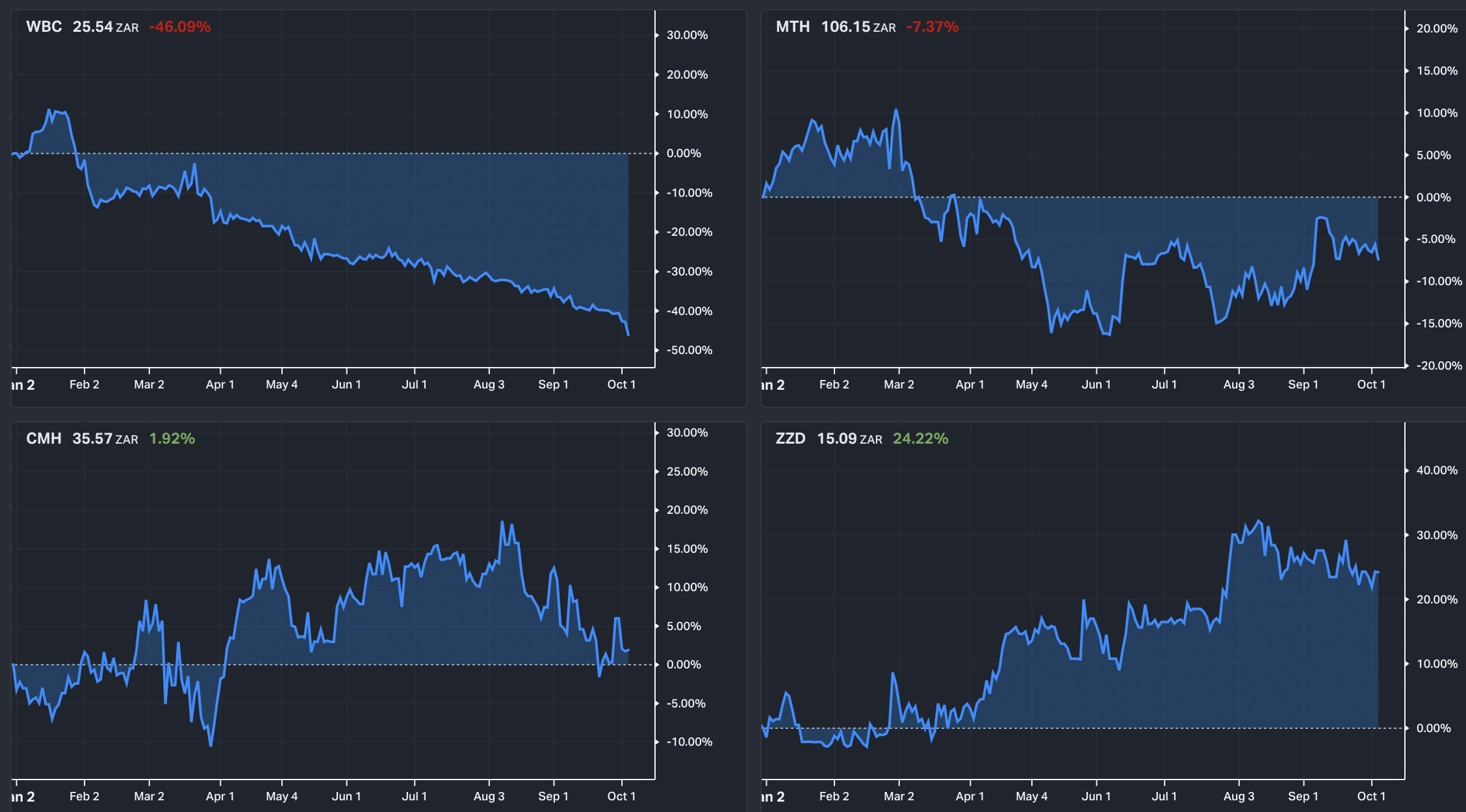
YTD charts | 05 October 2026
Key Takeaways 💡
- The volume boom is real but low-margin. New vehicle inflation is at a record low 1.2% and used prices are down 1.9%, so CMH grew revenue 18.6% with its operating margin stuck at 4.8%.
- Rental took 13.8% of September sales (18.4% of passenger cars). That fleet comes back as near-new used stock in six to twelve months, adding supply to a deflating used market.
- WeBuyCars’ R300k–R450k sweet spot now competes with new Chinese cars. A two-year-old Chinese used car averages R55,000 less than a non-Chinese one with a third of the mileage, and the interims show it: trading margin down to 12.5%, inventory days up to 33.2.
- With two rate hikes, fuel above R30 a litre and record volumes in the base, Simon sees this as late cycle and expects a weaker run to year end.
- The sector trades on single-digit PEs with 6–12% dividend yields. Simon’s order: Motus (~6x PE, 6.6% yield), Zeda for income (~4x PE, ~12% yield), CMH* as the pure SA play (he holds it), Super Group cheap but not a car story, WeBuyCars wait for the full-year trading statement, Metair avoid.
All charts by KoyFin | Get 10% off your order

Wednesdays are all about hard-core investing and trading with Simon Brown’s WorldWide Markets podcast (previously JSE Direct). JSE Direct started life on ClassicFM in July 2008 and became a podcast in 2011. Every week Simon shares his views on the state of global economies, individual shares and events moving markets.
Contact Simon
More about Simon


